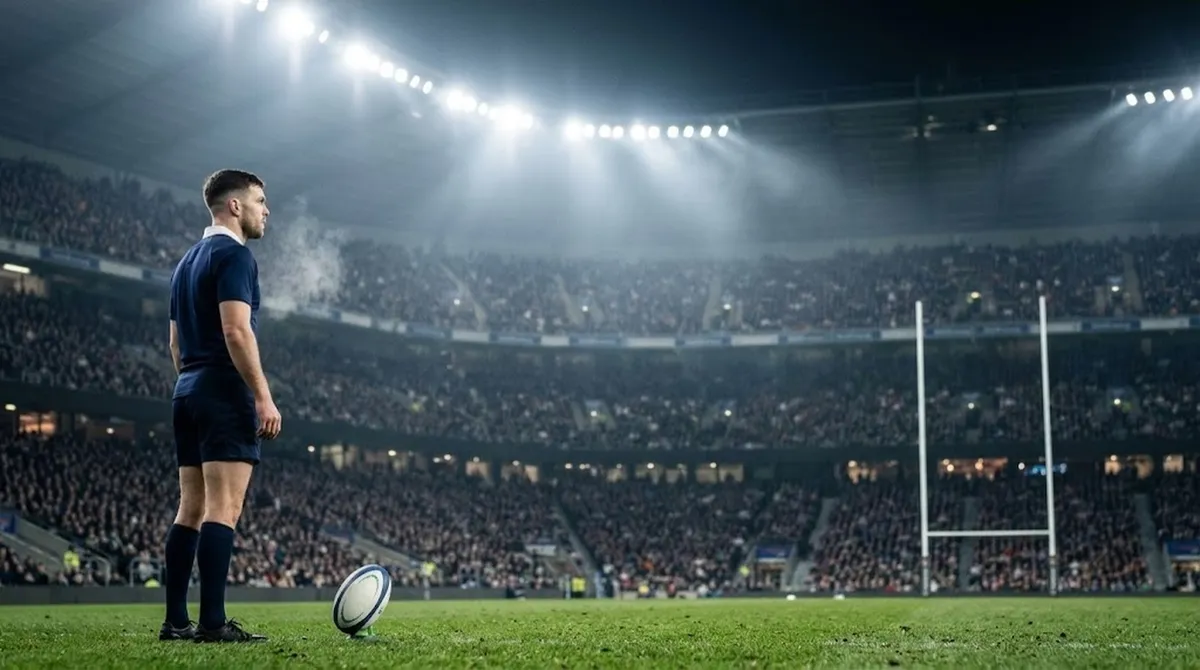
How to stay calm taking a kick under pressure in rugby
How do you stay calm taking a kick under pressure? You stay calm taking a kick under pressure by training your state before match day, then running one short breath-and-word routine on the pitch. Technique alone won't hold.
"I land these all week."
"My leg just went tight."
"I knew it was gone the second I hit it."
If you kick, you've said one of those. Maybe all three. The posts are the same width on Saturday as they were on Tuesday. The ball is the same ball.
The kick never changes. The kicker's state does.
In 30 seconds, if you're reading this on your phone between sessions:
You can land a kick 1,000 times in training and still miss it in a match. That is a state problem, not a skill problem.
Under pressure your attention leaves the target and moves to what happens if you miss.
An old habit your body built to protect you tightens the breath, the shoulders and the swing.
A 4-breath reset, practised at home and shortened on the pitch, trains the state the kick needs.
Why do I miss kicks in matches that I land in training?
You miss kicks in matches because pressure changes where your attention goes, not because your technique disappears. In training, your focus sits on the target. In a match, it slides to the scoreboard, the crowd and the cost of a miss.
The leg still knows the kick. But the kicker standing over the ball is in a different state. Sound familiar?
What happens in your body before a pressure kick?
Before a pressure kick, an old habit your body built to protect you switches on. Your breath goes high and fast. Your shoulders lift. Your grip on the moment tightens.
That habit is useful when you're in danger. Over a conversion from the touchline, it makes the swing careful. A careful swing is a different swing, and a different swing goes somewhere different.
Is it my technique or my head?
If you land the kick in training and miss it under pressure, it's your state, not your technique. Technique that works on Tuesday doesn't vanish by Saturday.
Would you agree the training was never the problem? Then more reps alone won't fix it. You need to train what happens before the kick, not only the kick.
What is the 4-breath reset for kickers?
Try this simple but powerful breathing technique. The 4-breath reset trains your body to stay calm when the pressure rises. You practise the long version at home and use the short version on the pitch.
At home, sitting down:
Take four straw breaths: in through the nose, hold a few seconds, slowly out through the mouth as if through a straw.
Say "relax" on every breath out.
On the fourth "relax", allow your eyes to close.
See the kick from your own eyes: the posts, the ball on the tee, the exact spot you're aiming at.
Hear it: the ground goes quiet, and all you notice is your own slow breath.
Feel it: your plant foot, the clean strike, the follow-through.
Watch it sail over, and let the calm settle in your chest.
Run it three times, then open your eyes.
Seeing, hearing and feeling the kick together makes the rehearsal real to your body. The more often it practises calm with the kick in mind, the more familiar that calm feels when the real one arrives.
On the pitch, before every kick: one straw breath, one "relax", eyes on the target. Then kick.
How long before match day should I start?
Start this week. Five minutes a day is enough to begin. Run the full version every night, and the short version before every kick in training, so match day feels like something you've already done.
Can you see how this could change the way you stand over the ball?
Does this work for other sports?
Yes. The sport changes the trigger. It never changes how it works. A golfer over a short putt, a tennis player serving for the set and a runner on the start line all feel the same pull. You can read more in Do you work with my sport?
One runner, Andrew Clair, put it this way: "I finished the run at 6:20, nearly 30 seconds faster than before meeting Enda." Individual results vary.
How to stay calm taking a kick under pressure? Quick answers
Can hypnosis help with goal kicking?
Hypnosis helps goal kickers by training the state behind the kick, not the kick itself. In hypnosis you're awake, focused and aware. You rehearse the pressure moment in detail until your body treats it as familiar. Then the routine you've trained has room to work when the real kick comes.
Why does my leg go tight before a big kick?
Your leg goes tight because pressure switches on an old habit your body built to protect you. Breath rises, muscles brace and the swing gets careful. It's a normal response, not a weakness. Training your breath and your focus before match day teaches your body a calmer response for the same moment.
Do I need to be relaxed for this to work?
You don't need to be relaxed for this to work. Relaxed is common, not required. You can be alert and focused on the pitch and still use the routine. The aim isn't to feel sleepy over the ball. The aim is to feel settled, clear and locked on the target.
What if I'm not a rugby kicker?
If you're not a rugby kicker, the same routine still applies. Free throws, penalties, putts, serves, darts, the start line: any moment where everything stops and it's just you. The trigger changes from sport to sport. The way pressure works in your body stays the same.
How do I know where pressure gets me?
The free Athlete's Edge Score quiz on endaoshea.com shows you where pressure gets you in about 2 minutes. It scores four areas of your mental game. Then the free 7-Day Athlete's Edge Reset gives you one short self-hypnosis session a day to train the calm.
Train the state. Then take the kick.
If one tight swing is keeping you from the kicks you land every Tuesday, doesn't it make sense to find out where pressure gets you, then train the calm every day?
Explore the free quiz and the free 7-Day Reset
Both free on endaoshea.com. The quiz takes about 2 minutes. The 7-Day Reset is one short self-hypnosis session a day.
 | Enda O'Shea |